
What is an SMSF and How Does It Work? 2026 Guide for Australians
By Yvette Lo
Share this article:


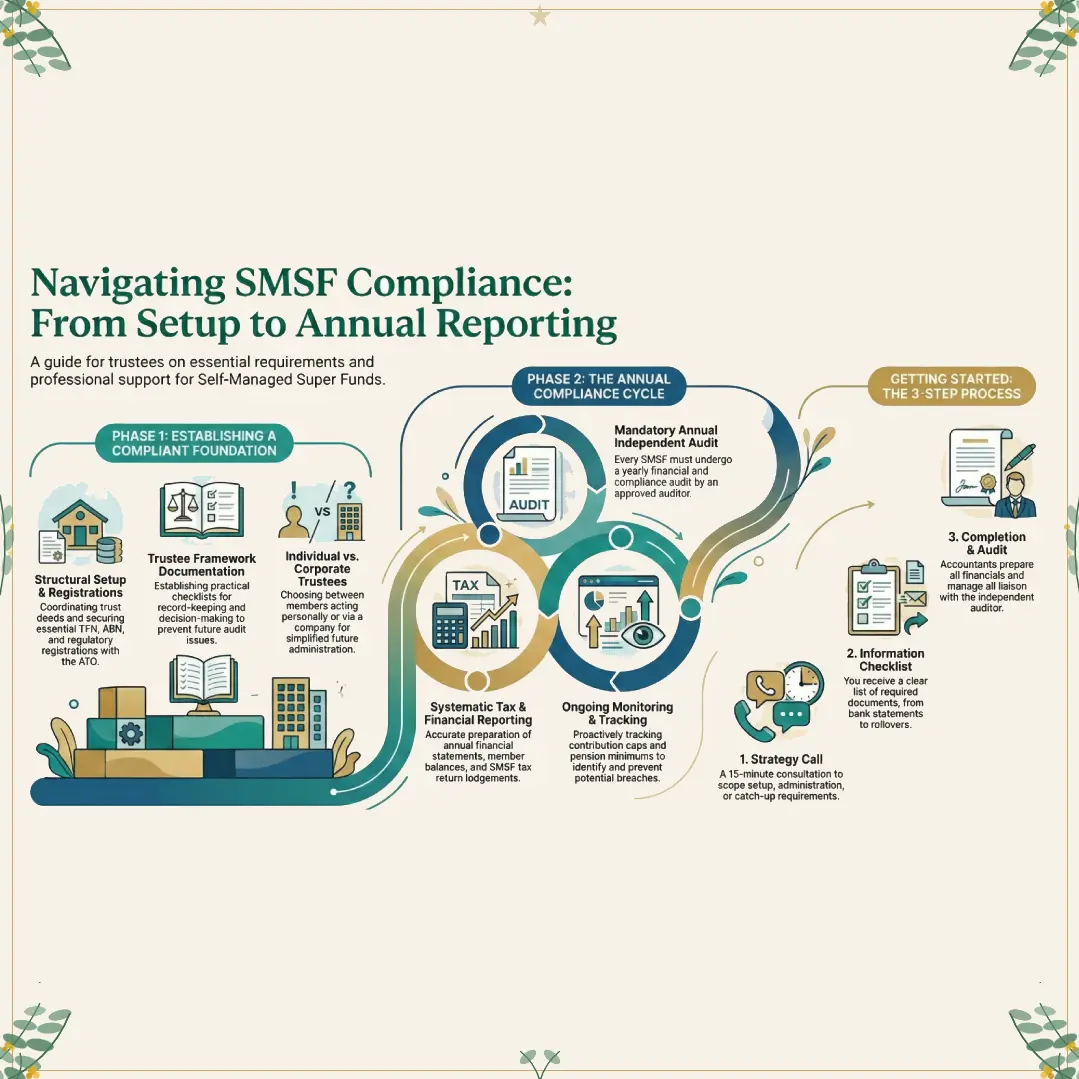


If you’re looking for greater control over your retirement savings, you’ve likely come across the term SMSF — a Self-Managed Super Fund. An SMSF is a private superannuation fund regulated by the Australian Taxation Office (ATO). It gives members direct control over investment decisions, contributions, and benefit payments.
In this comprehensive guide, we explain exactly what an SMSF is, how it works, the benefits and costs involved, and the strict compliance obligations trustees must meet.
What is a Self-Managed Super Fund (SMSF)?
A Self-Managed Super Fund (SMSF) is a private superannuation fund where the members are also the trustees (or directors of a corporate trustee). Unlike large industry or retail super funds, an SMSF is managed by you — the member(s) — giving you full control over where and how your retirement savings are invested.
SMSFs must still operate under the *Superannuation Industry (Supervision) Act 1993* (SISA) and strict ATO rules, with the sole purpose of providing retirement benefits to members.
How Does an SMSF Work? Structure and Governance
An SMSF is a trust with its own trust deed. All assets are held in the name of the trustee for the benefit of the members.
Key Structural Features
- Members: Maximum of 6 (minimum 1)
- Trustees: All members must be trustees (or directors of a corporate trustee)
- Governing Document: A compliant trust deed
- Investment Strategy: Must be documented and reviewed regularly
As trustee, you are legally responsible for ensuring the fund complies with all superannuation laws, including annual audits, contribution caps, and the sole purpose test.
Key Benefits of an SMSF
- Greater investment choice (direct property, unlisted assets, shares, term deposits, etc.)
- Ability to invest in your own business premises (under strict rules)
- Flexible contribution and pension strategies
- Estate planning advantages
- Potential tax benefits in pension phase
SMSF Costs – Is It Worth It?
Setting up and running an SMSF involves higher costs than a standard super fund. Typical annual costs range from $2,000–$5,000+ depending on complexity, number of members, and asset types. These include accounting, audit, tax return lodgement, and administration fees.
SMSFs generally become cost-effective when the fund balance exceeds $500,000–$750,000, though this varies by individual circumstances.
SMSF vs Industry Fund vs Retail Super – Comparison
| Feature | SMSF | Industry Fund | Retail Super Fund |
|---|---|---|---|
| Investment Control | Full control | Very limited | Limited |
| Investment Options | Very broad | Restricted | Moderate |
| Annual Cost | $2,000–$5,000+ | Usually lowest | Medium |
| Compliance Responsibility | Trustee (high) | Fund manages | Fund manages |
| Audit Required | Yes – independent each year | No | No |
| Best For | Larger balances, hands-on investors | Most Australians | Those wanting some choice |
Who Should Consider Setting Up an SMSF?
An SMSF is generally suitable for individuals or couples with:
- Super balances above $500,000–$750,000
- Interest in active investment management
- Desire for greater estate planning flexibility
- Time and willingness to meet compliance obligations
It is usually not suitable for people with small balances or those who prefer a fully hands-off approach.
How to Set Up an SMSF – Step-by-Step
- Decide on fund structure (individual vs corporate trustee)
- Engage a specialist to prepare a compliant trust deed
- Appoint trustee(s) and obtain TFN and ABN
- Register the SMSF with the ATO
- Open a bank account and rollover funds
- Prepare an investment strategy
- Establish proper record-keeping systems
Ongoing Compliance & Risks
SMSFs require strict annual compliance, including:
- Annual financial statements
- Independent SMSF audit
- Lodgement of the SMSF annual return
- Contribution cap monitoring
- Documented investment decisions
Breaches can result in significant penalties. Professional support from qualified SMSF accountants is highly recommended.
Common SMSF Mistakes to Avoid
- Failing to maintain proper minutes and documentation
- Breaching contribution caps
- Incorrect pension set-up or minimum drawdown rules
- Related-party transaction breaches
- Using the fund for personal benefit
Need expert help with your SMSF?
As Registered Tax Agents based in North Sydney, we specialise in SMSF setup, administration, annual accounts, audit coordination and SMSF annual returns. We provide Australia-wide virtual support to SME owners and high-income professionals.
Book a 15-Minute SMSF Setup & Compliance Call
Disclaimer: We provide SMSF tax, accounting and compliance services only. We do not provide personal financial product advice requiring an Australian Financial Services Licence (AFSL).
Frequently Asked Questions
How many members can an SMSF have?
An SMSF can have up to 6 members. All members must generally be trustees or directors of the corporate trustee.
What is the minimum balance for an SMSF to be worthwhile?
There is no strict minimum, but most experts suggest $500,000+ for cost-effectiveness. We can assess your situation and provide a quote.
Do I need an annual audit for my SMSF?
Yes. Every SMSF must have an independent audit each financial year by an approved SMSF auditor.
Can I buy property in my SMSF?
Yes, including residential or commercial property, but strict rules apply (especially with borrowing via LRBA and related-party transactions).
What’s the difference between an individual and a corporate trustee?
With an individual trustee, members act as trustees personally. With a corporate trustee, a company acts as trustee and members are directors. A corporate trustee can simplify administration when members change and can assist with consistent asset holding, but suitability depends on your situation.
How often does an SMSF need an audit?
SMSFs generally require an independent audit each financial year by an approved SMSF auditor. The audit covers both financial statements and compliance with superannuation rules.
Do you provide the SMSF audit?
No. The audit must be performed by an independent approved SMSF auditor. We provide audit coordination—preparing documents, liaising with the auditor, and managing timelines.
What happens if I breach contribution caps?
Breaches can lead to additional tax and ATO processes. Trustees should monitor concessional and non-concessional contributions carefully. Where we provide ongoing compliance support, we can help track contributions and flag issues early.
Can you help if my SMSF is already established?
Yes. We can assist with ongoing administration, bookkeeping support, annual financial statements, the SMSF annual return, and audit coordination. If there are outstanding prior-year matters, we can scope a catch-up plan.
-
 CEO & Founder

Share this article:


About Abundance Empowered Financial Solutions
Yvette Lo founded Abundance Empowered to bring enterprise-level financial strategy to Australian small businesses. With over a decade of commercial accounting experience managing billion-dollar company finances, Yvette specialises in transforming bookkeeping from compliance task into strategic advantage. Based in North Shore Sydney, Abundance Empowered serves small businesses throughout Australia through cloud-based platforms, offering bookkeeping, BAS services, strategic advisory, tax planning, and complete financial partnership.
Ready to Take Control of Your Finances?
Stop the financial leaks and build strength ahead of 2026 changes. Contact us today for a free, no-obligation consultation.

