
The 80% Rule for Sole Traders in Australia: What It Actually Means (and Why It Matters)
By Yvette Lo
Share this article:


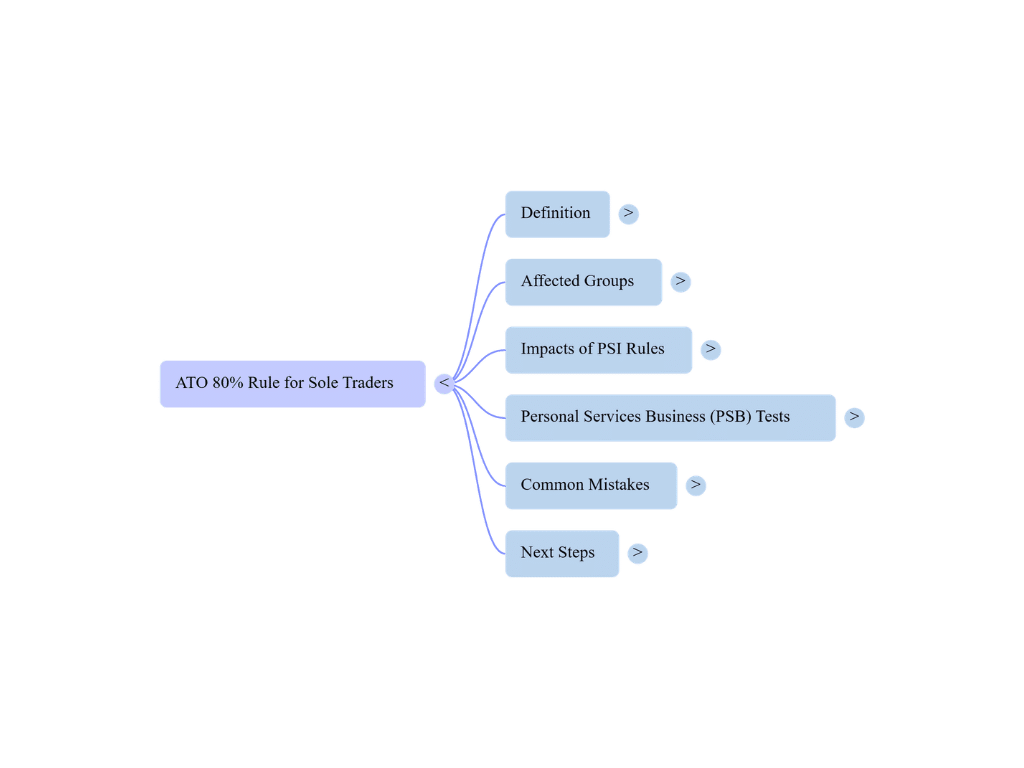


If you’ve searched ‘the 80% rule for sole traders’ hoping to find a handy budgeting tip, you might be surprised — because in Australia, the 80% rule is an ATO tax rule with real consequences for how you report your income and what you can deduct.
This post explains what the rule actually is, when it applies to you, and what to do if you’re caught by it.
What the 80% Rule Actually Is
The 80% rule is part of Australia’s Personal Services Income (PSI) legislation. PSI rules apply when most of your income comes from your personal skills, effort, or expertise — rather than from selling goods, using equipment, or employing others to do the work.
The 80% rule is a specific test within that framework. It asks one question:
| The 80% Test Do 80% or more of your personal services income come from a single client (or a group of associated clients) in an income year? |
If the answer is yes, the PSI rules apply to you. This affects what business deductions you can claim and how you report your income — even if you’re operating as a legitimate sole trader or through a company.
If the answer is no (less than 80% from one source), you may still need to pass one of the other PSI tests — but you’ve cleared this particular hurdle.
Who Does the 80% Rule Affect?
The rule most commonly catches:
- IT contractors and consultants working primarily for one business
- Freelancers or specialists on long-term engagements with a single client
- Tradespeople or professionals seconded exclusively to one organisation
- Anyone operating through a company or trust but personally providing the services
You don’t have to be a sole trader in the traditional sense. The PSI rules can also apply if you operate through a company, partnership, or trust — the 80% rule is assessed at the individual level regardless of your business structure.
A Simple Example
| Example Priya is a UX designer who works as a sole trader. In the 2024-25 financial year, she earns $120,000. Of that, $100,000 comes from one tech company she’s embedded with full-time. The remaining $20,000 comes from two smaller clients. Because $100,000 out of $120,000 (83%) comes from one client, Priya fails the 80% rule. PSI rules apply to her income from that client. |
This doesn’t mean Priya is doing anything wrong. It just means her deductions are restricted and she must report her income differently.
What Happens If the PSI Rules Apply to You?
When PSI rules apply, the main impacts are:
Restricted deductions
You can no longer claim certain deductions that a normal business could claim, including:
- Rent, mortgage interest, or occupancy expenses for your home or business premises
- Payments to associates (e.g., paying a spouse or family member)
- Superannuation contributions for associates
- Some business-related travel and vehicle expenses
Income attribution
If you’re operating through a company or trust, the income may need to be attributed back to you personally and taxed at your individual rate — removing the benefit of splitting income or retaining it in the entity.
Can You Get Around the 80% Rule?
There are legitimate ways to avoid PSI rules applying, but they require meeting specific ATO tests. You can self-assess as a Personal Services Business (PSB) if you either:
- Pass the results test — you’re being paid for a specific result, you supply your own tools, and you’re liable to fix defective work at your own cost
- Pass one of the other PSB tests (unrelated clients, business premises, or employment test) AND meet the 80% rule (i.e., less than 80% from one client)
If you’re not sure whether you meet any of these tests, this is exactly the kind of question worth putting to an accountant before you lodge — not after.
Common Mistakes Sole Traders Make With PSI
- Assuming PSI doesn’t apply because they’re structured as a company — the rules apply to the individual, not the entity
- Claiming home office or premises deductions without checking whether PSI rules restrict them
- Not realising that income from associated clients counts as one source — two subsidiaries of the same parent company are treated as one client
- Waiting until tax time to deal with it, when the financial year has already closed
| Important note The ATO can and does audit sole traders and contractors on PSI. If PSI rules apply and you’ve claimed restricted deductions, you may face amended assessments, interest, and penalties. It’s worth getting this right. |
What to Do Next
If you’re a sole trader or contractor in Sydney and you’re not sure whether PSI applies to you, here’s where to start:
- Work out what percentage of your income came from each client in the last financial year
- Check whether any clients are associated with each other — their income counts as one source
- If 80% or more came from one source, check whether you meet the results test
- If you’re unsure, talk to an accountant before you lodge
The ATO also has a PSI tool on their website that can help you work through the tests, but it has limitations — it won’t tell you how to structure your affairs going forward, or whether deductions you’ve already claimed are at risk.
Not Sure Whether PSI Applies to You?
PSI is one of those areas where a short conversation with an accountant can save a lot of headache down the track. As an independent accountant working with sole traders and small businesses in Sydney, I help clients understand exactly where they stand with the ATO — and how to structure things properly from the start.
Book a free 20-minute call and let’s talk through your situation.
-
 CEO & Founder

Share this article:


About Abundance Empowered Financial Solutions
Yvette Lo founded Abundance Empowered to bring enterprise-level financial strategy to Australian small businesses. With over a decade of commercial accounting experience managing billion-dollar company finances, Yvette specialises in transforming bookkeeping from compliance task into strategic advantage. Based in North Shore Sydney, Abundance Empowered serves small businesses throughout Australia through cloud-based platforms, offering bookkeeping, BAS services, strategic advisory, tax planning, and complete financial partnership.
Ready to Take Control of Your Finances?
Stop the financial leaks and build strength ahead of 2026 changes. Contact us today for a free, no-obligation consultation.

