
Instant Asset Write-Off $20000 2026: Sydney Small Business Tax Savings Before 30 June Deadline
By Yvette Lo
Share this article:


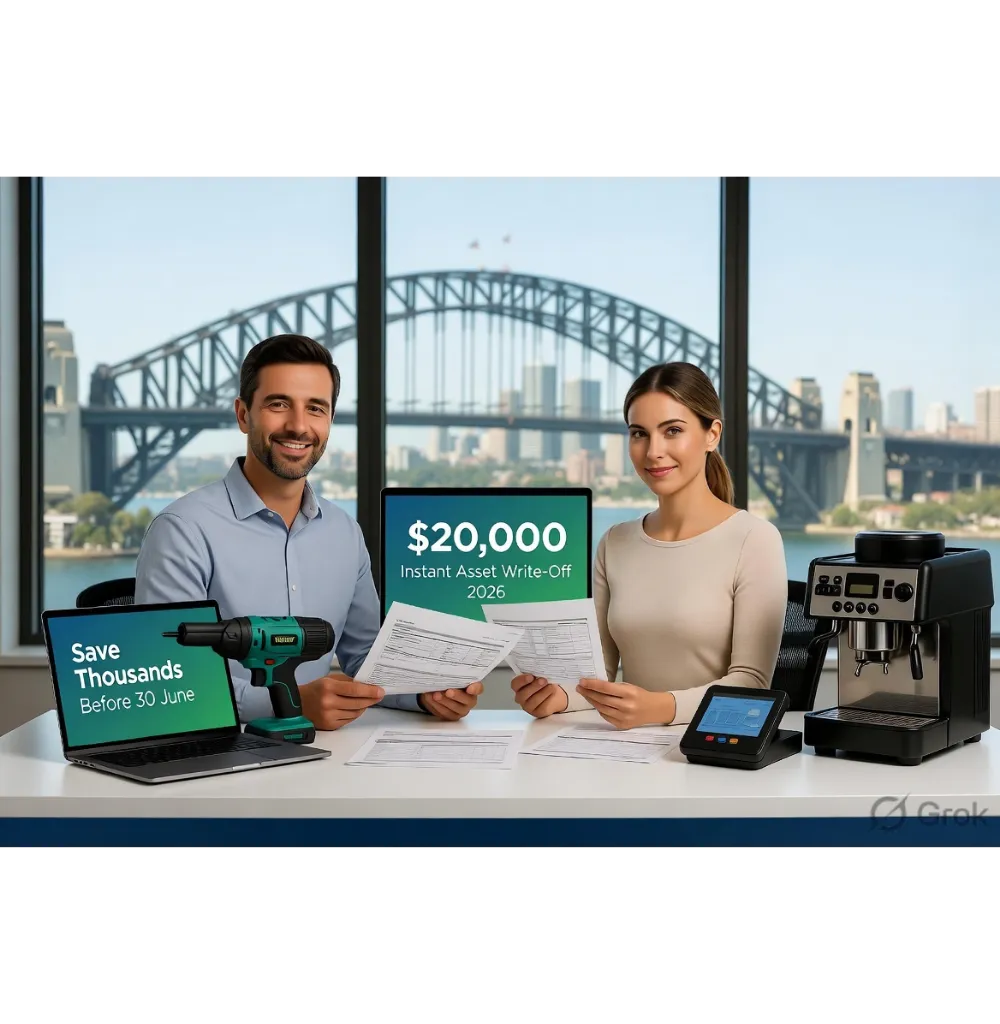


Instant Asset Write-Off $20000 2026: How Sydney Small Businesses Can Save Thousands Before 30 June Deadline
There’s a particular vibe in Sydney when EOFY is approaching. The cafés are buzzing, the tradies are flat out, and my inbox? It starts behaving like it’s training for the City2Surf. Every second message is some version of:
-
- “Can I buy the thing and claim the thing?”
- “Does it have to be delivered by 30 June?”
- “If I order it at 11:59pm on 30 June… does the ATO count that?”
And honestly, I get it. Sydney is not a “let’s leave money on the table” kind of town. Rent is high, wages are real, and the cost of running a small business can feel like you’re paying a premium subscription for the privilege of being stressed.
That’s why the instant asset write-off $20000 2026 is one of the most valuable EOFY opportunities still on the table for eligible small businesses. It’s simple in concept (love that), but the rules around timing and eligibility can get surprisingly fussy (less love, but we manage).
At Abundance Empowered Accounting (Sydney), I’ve helped hundreds of local businesses—tradies, consultants, clinic owners, agencies, ecommerce operators, hospitality venues—use this concession to bring forward deductions, improve cash flow, and make smarter equipment decisions instead of panic-buying something random on 29 June (yes, that happens… more than you’d think).
Let me walk you through exactly how it works for 2025–26, what you can (and can’t) claim, the biggest traps I see Sydney businesses fall into, and how to turn this into a genuine strategy—not just an EOFY scramble. 😄
Quick EOFY Snapshot (Sydney Business Owners, Save This)
If you only read one section, make it this one.
✅ Eligible small businesses (generally with aggregated turnover under $10 million) can potentially claim an immediate deduction for each eligible asset that costs less than $20,000.
✅ It’s available for assets first used or installed ready for use between 1 July 2025 and 30 June 2026.
✅ It applies per asset (not per invoice), which is where the strategy really opens up.
✅ The asset can be new or second-hand.
✅ If you’re GST-registered, the threshold is based on the GST-exclusive amount.
Source (ATO): Instant asset write-off and the $20,000 threshold extension details are covered by the ATO guidance for small business depreciation and the $20,000 write-off measure. See:
-
- ATO – $20,000 instant asset write-off (measure detail): https://www.ato.gov.au/about-ato/new-legislation/in-detail/businesses/small-business-support-20000-dollar-instant-asset-write-off
- ATO – Instant asset write-off (small business): https://www.ato.gov.au/businesses-and-organisations/income-deductions-and-concessions/depreciation-and-capital-expenses-and-allowances/simpler-depreciation-for-small-business/instant-asset-write-off
What Is the Instant Asset Write-Off $20000 2026 (In Plain English)?
The instant asset write-off (IAWO) is part of the ATO’s simplified depreciation rules for small business.
Normally, if you buy a business asset—like a laptop, tools, equipment, or a POS system—you don’t deduct the whole cost straight away. You depreciate it over time (its “effective life”), which means the tax benefit drips out slowly.
With the instant asset write-off $20000 2026, eligible businesses can deduct the business portion immediately in the year the asset is:
-
- first used, or
- installed ready for use,
as long as it costs less than $20,000 (per asset) and meets the rules.
And yes, this is one of those concessions that can feel almost too good to be true, which is why the ATO is very specific about the words “installed ready for use”.
Why This Matters So Much in Sydney (Where Cash Flow Is a Competitive Sport)
Sydney businesses are often juggling:
-
- higher-than-average rent and fit-out costs
- staff shortages and wage pressure
- transport and logistics costs (especially across Greater Sydney)
- fierce competition and thin margins
So when you can bring forward deductions and reduce your tax payable, it can directly support:
-
- buying equipment you genuinely need
- upgrading systems that speed up delivery
- reducing downtime (especially for tradies and clinics)
- keeping more cash in the business during expansion
I’ve seen this write-off help businesses stabilise cash flow at exactly the moment they needed to hire a new team member, take on a bigger contract, or invest in systems that stop the owner from doing payroll at midnight.
Eligibility: Who Can Claim the Instant Asset Write-Off $20000 2026?
You can generally access the write-off if you:
-
- Carry on a business (sole trader, partnership, company, or trust), and
- Have aggregated annual turnover under $10 million, and
- Use the simplified depreciation rules (or elect into them where relevant), and
- Purchase eligible assets that are first used or installed ready for use between 1 July 2025 and 30 June 2026.
That includes a huge slice of Sydney’s small business community, such as:
-
- builders and tradies across the Inner West, Hills District, and Western Sydney
- café owners and hospitality groups in the CBD, Surry Hills, Parramatta, and Chatswood
- health and allied health practices (physio, dental, medical specialists)
- ecommerce brands shipping from warehouses in Alexandria or Silverwater
- consultants, agencies, and professional services firms on laptops and software stacks
ATO reference: The ATO’s small business depreciation rules and eligibility are outlined in their instant asset write-off and simplified depreciation guidance.
The Rule That Trips People Up: “Installed Ready for Use” (Not Just “Paid For”)
Let me tell you about the most common Sydney EOFY heartbreak I see.
A business owner buys an asset on 29 June. They pay the invoice. They feel smug (in a justified way). Then they send it to me on 1 July saying, “All good—we’ll claim it this year.”
And then I ask one question:
“Was it installed and ready to use by 30 June?”
Cue the long pause. 😬
Here’s the point: for the deduction to apply in the 2025–26 year, the asset needs to be first used or installed ready for use by 30 June 2026 (not merely ordered).
Examples:
-
- ✅ Laptop bought, set up, and used in the business before 30 June
- ✅ Coffee machine installed and operating in the café before 30 June
- ✅ Work trailer fitted out, registered, and ready for jobs before 30 June
- ❌ “It’s on backorder until mid-July”
- ❌ “It arrived but we haven’t installed it yet”
- ❌ “We’re waiting on a technician to set it up next month”
ATO reference: The ATO specifically uses the “first used or installed ready for use” test.
The $20,000 Threshold: What Exactly Does It Mean?
It’s per asset, not per invoice
This is where smart planning can make a big difference.
If you purchase multiple assets, each costing less than $20,000, you can potentially write off each one (subject to eligibility and business use).
For example, you might buy:
-
- a laptop ($2,700)
- a monitor ($600)
- a portable printer ($450)
- a phone ($1,600)
- a POS terminal ($1,400)
- shelving ($3,800)
- a security camera system ($2,900)
Each asset is under $20,000, so each may potentially qualify.
GST treatment matters
If you’re GST-registered, the $20,000 threshold is generally considered GST-exclusive.
If you’re not GST-registered, the cost is GST-inclusive (because that’s your real cost).
This is a surprisingly common mistake, especially for growing businesses that registered for GST mid-year.
What Assets Can You Claim? (Real Examples I See in Sydney)
Here are common asset categories Sydney small businesses frequently claim under the instant asset write-off $20000 2026—assuming they meet the eligibility rules and are used for business.
Tradies and construction businesses
-
- tools and trade equipment
- nail guns, compressors, laser levels
- jobsite radios (yes, I’m counting it—if it’s a business asset, it’s a business asset)
- ladders, scaffolding components (where they qualify as depreciating assets)
- trailers under $20,000
- tool storage systems and shelving
Offices, agencies, consultants, and professional services
-
- laptops, desktops, monitors, docks
- ergonomic chairs and office furniture
- meeting room equipment (screens, conferencing gear)
- servers and networking equipment
- security systems
- scanners, printers, and postage equipment
Retail and hospitality
-
- POS systems, EFTPOS terminals, receipt printers
- refrigeration units under $20,000
- coffee grinders, commercial blenders
- kitchen prep equipment
- display fridges (eligible where they qualify as depreciating assets)
- CCTV systems and alarms
Health and medical practices
-
- dental chairs or components under threshold
- sterilisation units under threshold
- practice equipment and diagnostic tools
- computers and patient management hardware
- specialised chairs, beds, and clinical furniture
Content creators and ecommerce businesses
-
- cameras and lenses under $20,000
- lighting rigs
- microphones and audio equipment
- warehouse label printers and packing benches
- photography backdrops and staging equipment
- computers and editing workstations (when under threshold)
What You Cannot Claim Under the Instant Asset Write-Off (Common Confusion)
This is where my “boring accountant voice” has to make a brief appearance.
The instant asset write-off applies to eligible depreciating assets. It does not automatically apply to everything you spend money on.
Common items that don’t fall into this concession (or are frequently misunderstood):
-
- business services (marketing retainers, consulting fees, subscriptions)
- repairs and maintenance (these may be deductible, but they’re not “assets” for depreciation)
- trading stock (stock is not a depreciating asset)
- land and buildings (and many building improvements fall under capital works, not depreciating assets)
- private purchases dressed up as “business development” (please don’t do this to yourself—or to your accountant)
If you’re unsure whether something is a depreciating asset, that’s exactly what we clarify in an EOFY tax planning session—before you spend the money.
A Sydney Reality Check: The Instant Asset Write-Off Is Not a “Spend Money to Save Tax” Licence
I’m going to say the quiet part out loud:
A deduction is not a refund.
If you spend $18,000 on equipment you don’t need, you have not “won” EOFY. You’ve simply swapped cash for an asset—possibly a useful asset, but still.
Here’s how I think about it (and how I advise clients):
-
- If the asset will increase revenue, reduce operating costs, or reduce downtime, it’s often worth considering.
- If it’s just to “get the tax deduction”, it’s usually not.
The best EOFY strategy is not shopping. It’s planning.
The Best Time to Act (And Why “Later” Becomes “Never”)
The earlier you plan, the more options you keep:
-
- Stock availability (Sydney EOFY backorders are real)
- Installation lead times
- Booking technicians and fit-out specialists
- Getting proper invoices and finance approvals
- Ensuring the business use is documented
If you’re reading this with less than a month to go, you still have time—but you need to move decisively and thoughtfully.
How the Deduction Works in Practice (With Simple Numbers)
Let’s use a straightforward example.
Say you run a small studio in Sydney. You purchase a new editing laptop for $6,000 (GST-exclusive), and you use it 100% for business. It’s installed and ready to use before 30 June 2026.
If you qualify for the instant asset write-off, you may be able to claim an immediate deduction of:
-
- $6,000 in your 2025–26 return.
Now, what does that mean in tax saved? It depends on your structure and taxable income (sole trader rates differ to company rates, etc.). The instant asset write-off reduces taxable income, which can reduce tax payable, but it’s not a dollar-for-dollar refund.
This is why we run the numbers properly—because the best strategy is often a combination of:
-
- timing purchases,
- timing income (where legitimately possible), and
- choosing the right structure and remuneration strategy.
The “Multiple Assets” Strategy (Per Asset Basis)
One of the most powerful parts of the rule is that it applies per asset.
So if you invest in several business-critical items—each under $20,000—you may be able to write off multiple assets in the same year.
I often see this used strategically by Sydney businesses that are:
-
- upgrading an entire POS system across a retail site
- fitting out a new room in a clinic
- upgrading a team’s computers for better productivity
- equipping a new service vehicle with tools and storage systems
It’s not about “spending for the sake of it”. It’s about aligning equipment upgrades with a tax-smart timeline.
Vehicles: Can I Claim a Vehicle Under $20,000?
If a vehicle costs less than $20,000 (GST-exclusive if you’re GST registered), and it otherwise qualifies as a depreciating asset used in the business, it may potentially qualify.
However, vehicles often come with extra complexity:
-
- private use apportionment
- logbook requirements (where applicable)
- running cost substantiation
- finance arrangements and when the asset is considered “held” and “ready for use”
Also, in Sydney, vehicle purchases under $20,000 can be… character building. You can absolutely find them, especially for certain commercial vehicles or used vehicles, but the key is ensuring it genuinely suits the business and meets the timing rules.
This is an area where I strongly recommend getting advice before you sign.
Second-Hand Assets: Yes, They Can Count (And Sydney Businesses Love This)
This is one of my favourite parts of the rules, particularly in Sydney where:
-
- fit-outs change hands
- cafés get refurbished
- businesses relocate
- equipment gets sold in liquidation or upgrade cycles
The instant asset write-off can apply to second-hand assets too, as long as they meet the eligibility conditions.
Examples I’ve seen clients buy second-hand:
-
- commercial fridges
- coffee machines
- shelving and storage systems
- trailers
- photography equipment
As always: you need a valid invoice/receipt, and you need to be able to show business use.
The Five Most Common Mistakes I See Sydney Businesses Make (And How I Help You Avoid Them)
1) Buying the asset but not having it “ready to use” by 30 June
Fix: confirm delivery and installation timelines before purchase.
2) Using the wrong threshold amount because of GST confusion
Fix: confirm GST registration status and apply the correct GST-inclusive/exclusive amount.
3) Forgetting to apportion for private use
Fix: document business use percentage, keep logbooks where needed, and maintain records.
4) Thinking the $20,000 threshold applies to the whole invoice
Fix: treat it per asset, and ensure items aren’t actually one combined asset.
5) Missing the deadline and falling back to lower thresholds/rules later
Fix: start your EOFY planning early (May is ideal; early June is still workable; late June is where my eye starts twitching).
My EOFY 2026 Instant Asset Write-Off Checklist (Practical, Not Theoretical)
If you’re planning to claim the instant asset write-off $20000 2026, here’s my practical checklist.
Step 1: Confirm you’re eligible
-
- aggregated turnover under $10m
- business structure confirmed
- simplified depreciation rules apply (or election considered)
Step 2: Confirm the asset qualifies
-
- is it a depreciating asset?
- is it under $20,000 per asset?
- new or second-hand is fine, but you need proof of purchase
- business use percentage is supportable
Step 3: Confirm timing
-
- ordered is not enough
- must be installed ready for use by 30 June 2026
Step 4: Get documentation right (before EOFY chaos)
-
- tax invoice with supplier ABN
- finance contract (if applicable)
- delivery/installation proof
- any relevant internal approvals (for companies/trusts)
Step 5: Make it part of a wider tax plan
-
- don’t just buy assets—plan taxable income, super, wages, trust distributions, and cash flow together
This is exactly what we do in our EOFY strategy sessions—because the best tax outcomes come from coordination, not guesswork.
A Few “From the Desk” Stories (Because EOFY Always Delivers)
The “I Bought It But It’s In A Box” Saga
One year, a business owner proudly forwarded an invoice for a high-end piece of equipment purchased on 28 June. Great. Except it arrived on 30 June and sat in the corner—still boxed—until mid-July because the installer was booked out.
Their words: “But it’s here.”
My words (gently): “The ATO cares less about ‘here’ and more about ‘ready for use’.”
We worked through options and timing, and most importantly, we changed the planning process going forward. The next year? Smooth, strategic, and zero cardboard-box drama.
The “Per Asset” Lightbulb Moment
Another client assumed the $20,000 threshold was a total cap. They were trying to choose between three things their business genuinely needed.
Once we clarified it was per asset, they were able to invest in multiple items—each under the threshold—without the false limitation they’d been carrying around. It wasn’t about “spending more”. It was about removing confusion so they could make the right decision.
The “I Nearly Bought Something Silly” Confession
This is my favourite category. I have a soft spot for the honest ones.
A business owner once told me they were about to buy a very expensive piece of tech they didn’t need because a friend said, “It’s deductible.”
We ran the numbers. We talked cash flow. We considered what would actually increase profit. They didn’t buy the shiny thing. Instead, they invested in systems and equipment that reduced labour time—and that was the real win.
How Abundance Empowered Accounting Helps Sydney Businesses Maximise the Instant Asset Write-Off $20000 2026
I’m going to be candid: tax deductions are easy to talk about, but the value is in execution—clean records, correct timing, correct classification, and a plan that fits your business.
Here’s what we do differently at Abundance Empowered Accounting:
1) EOFY tax strategy (not just compliance)
We map your:
-
- expected taxable income
- upcoming asset needs
- cash flow and financing capacity
- timing risks (delivery and installation)
2) Asset purchase planning before 30 June
If you’re investing in equipment, we help you:
-
- confirm whether it’s likely to qualify
- understand business-use apportionment
- structure documentation properly
- avoid the “it arrived but wasn’t ready” trap
3) Full compliance support and ATO-ready records
We focus on:
-
- clear substantiation
- correct depreciation treatment
- correct GST handling
- clean separation of business vs private use
4) Cash flow forecasting for Sydney conditions
Sydney’s seasonality and cost base are unique. We build forecasts that reflect:
-
- rent, wages, supplier pressure
- realistic revenue cycles
- instalment activity (PAYG, GST, etc.)
5) Ongoing quarterly reviews (so EOFY is not a surprise)
The most profitable clients I work with don’t “do tax” once a year. We monitor and adjust.
FAQ: Instant Asset Write-Off $20000 2026 (Sydney Small Business Edition)
Can I claim the instant asset write-off if I finance the asset?
Often, yes—financing doesn’t automatically prevent a deduction. What matters is that you hold the asset, it’s a depreciating asset, it’s installed ready for use in time, and the other eligibility rules are satisfied. Finance structures can change the documentation and timing details, so get advice before signing.
Does “ordered before 30 June” count?
Not by itself. The key test is generally first used or installed ready for use by 30 June 2026. (ATO wording is very specific on this point.)
What if I use the asset partly for personal use?
You generally claim only the business portion. This is a common issue for phones, laptops, and vehicles.
What if the asset costs exactly $20,000?
The threshold is for assets costing less than $20,000. “Exactly $20,000” may not qualify under the “less than” wording. This is one of those details where a $1 difference matters—so check the invoice carefully and consider whether the cost can be legitimately separated into distinct assets where appropriate.
What happens after 30 June 2026?
Based on ATO guidance, the threshold is expected to revert to a lower amount unless extended by the Government. The ATO provides updates on legislation and current thresholds.
Sydney EOFY Action Plan (What I Recommend Doing This Week)
If you want the instant asset write-off $20000 2026 to genuinely improve your business (not just your stress levels), here’s what I recommend right now:
-
- List the assets you actually need in the next 6–12 months (not just “nice-to-haves”).
- Confirm pricing per asset and whether each is under the $20,000 threshold.
- Check lead times for delivery and installation (especially for fit-outs and specialised equipment).
- Assess cash flow—purchase vs finance vs staging purchases.
- Book an EOFY tax strategy session so your asset decisions sit inside a broader plan.
This approach consistently produces better outcomes than the “late June impulse buy”.
Ready to Claim Your $20,000 Instant Asset Write-Off in 2026?
If you’re a Sydney small business owner and you want to:
-
- maximise your deductions,
- protect your ATO position, and
- improve cash flow heading into the new financial year,
I’d love to help.
Book your EOFY consultation with Abundance Empowered Accounting (Sydney)
We’ll review your planned purchases and show you, clearly, what may qualify and how to structure it properly before 30 June 2026.
-
- 📍 Serving: Sydney CBD, North Shore, Eastern Suburbs, Inner West, Parramatta, Hills District & Greater Sydney
- 📞 Book online
- 💼 Same-week appointments available (EOFY spots fill quickly)
Recommended internal links (add on your site):
-
- Small Business Tax Services Sydney (internal link)
- EOFY Tax Planning 2026 (internal link)
- Book a Consultation (internal link)
Sources (ATO References)
-
- ATO – Small business support: $20,000 instant asset write-off: https://www.ato.gov.au/about-ato/new-legislation/in-detail/businesses/small-business-support-20000-dollar-instant-asset-write-off
- ATO – Instant asset write-off (small business depreciation): https://www.ato.gov.au/businesses-and-organisations/income-deductions-and-concessions/depreciation-and-capital-expenses-and-allowances/simpler-depreciation-for-small-business/instant-asset-write-off
-
 CEO & Founder

Share this article:


About Abundance Empowered Financial Solutions
Yvette Lo founded Abundance Empowered to bring enterprise-level financial strategy to Australian small businesses. With over a decade of commercial accounting experience managing billion-dollar company finances, Yvette specialises in transforming bookkeeping from compliance task into strategic advantage. Based in North Shore Sydney, Abundance Empowered serves small businesses throughout Australia through cloud-based platforms, offering bookkeeping, BAS services, strategic advisory, tax planning, and complete financial partnership.
Ready to Take Control of Your Finances?
Stop the financial leaks and build strength ahead of 2026 changes. Contact us today for a free, no-obligation consultation.

