
How to Create a Small Business Budget in Australia (That You’ll Actually Use)
By Yvette Lo
Share this article:


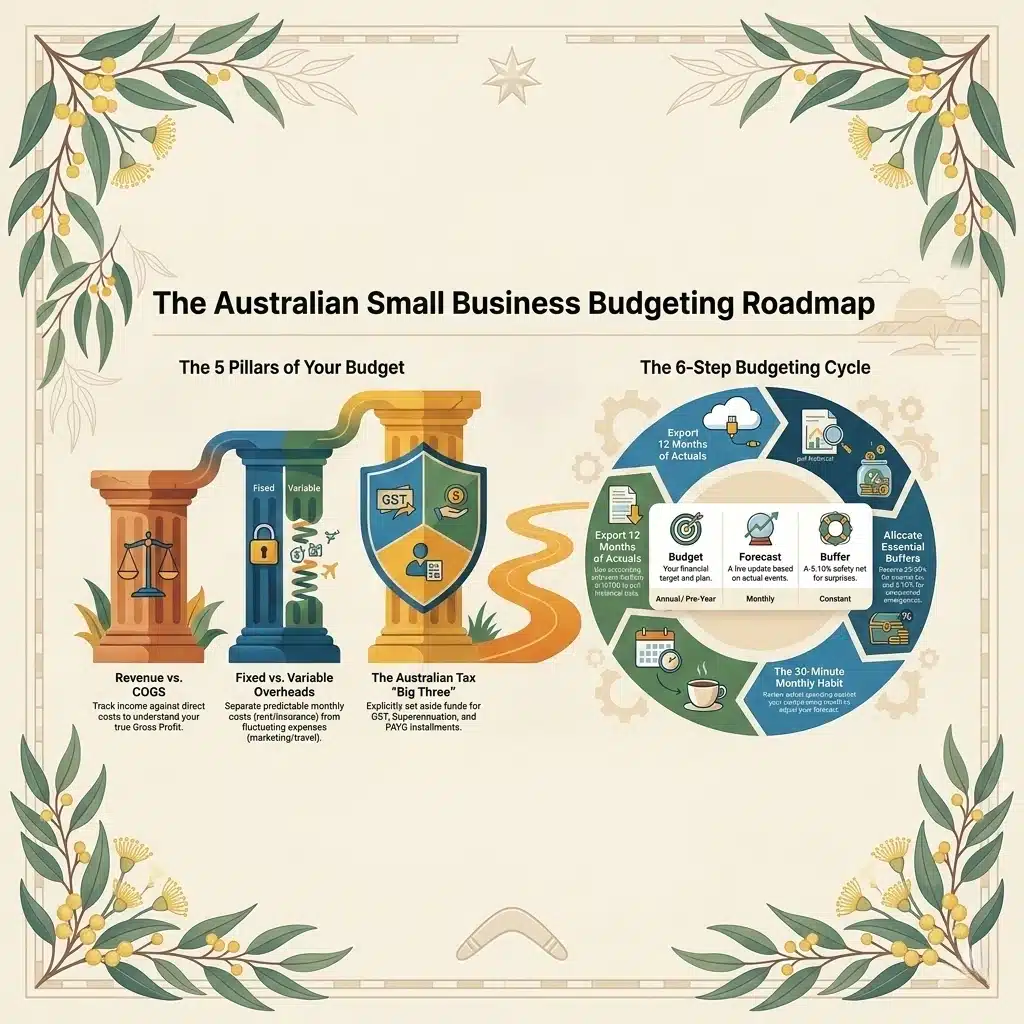


Most small business owners know they should have a budget. Far fewer actually have one that’s current, accurate, and doing anything useful for their business.
That’s not a character flaw — it’s usually a process problem. Budgeting gets pushed down the priority list because it feels complicated, time-consuming, or like something that only matters at tax time. But for small businesses in Australia, a solid budget is one of the most practical tools you have for staying cash-flow positive, making confident decisions, and avoiding nasty surprises.
This guide walks you through what a small business budget should actually include, how to build one step by step, and where most business owners go wrong.
What Is a Business Budget — and How Is It Different from a Forecast?
These two terms are often used interchangeably, but they serve different purposes.
| Budget vs Forecast A budget is your financial plan — what you intend to earn and spend over a set period, typically 12 months. A forecast is a live update based on what’s actually happening. Think of the budget as your target, and the forecast as your updated estimate of whether you’ll hit it. |
Both are useful. But the budget comes first, and it should be built before your financial year begins — not halfway through when things have already gone sideways.
What a Small Business Budget Should Include
A useful budget for an Australian small business typically covers five areas:
1. Revenue
Break your expected income into categories: recurring revenue from ongoing clients or contracts, expected revenue from known but not confirmed work, and any seasonal or one-off income. Being realistic here matters — overstating revenue leads to overspending.
2. Cost of goods sold (COGS)
The direct costs involved in delivering your product or service. For a service business this might be contractor costs, materials, or software. For a product business, it’s your inventory and production costs.
3. Fixed overheads
Your predictable monthly costs: rent, insurance, utilities, subscriptions, loan repayments, accountant fees. These don’t change much regardless of how much revenue you bring in.
4. Variable expenses
Costs that fluctuate with activity: marketing spend, travel, equipment, staff overtime. These are often the easiest to cut — but also the easiest to let creep up unnoticed.
5. Tax and super obligations
This is where many Australian small businesses come unstuck. Your budget needs to set aside for:
- Income tax on profits (paid as PAYG instalments if applicable)
- GST collected — remember, this money is never yours to spend
- Superannuation guarantee contributions if you have employees
- BAS lodgement quarters — plan for these dates in advance
| Common mistake Many small business owners budget based on their bank balance rather than their profit. If you’re collecting GST, a healthy-looking bank balance can be misleading — a significant portion of that money belongs to the ATO. Always budget on GST-exclusive figures. |
How to Build Your Budget: A Practical Step-by-Step
- Pull your last 12 months of actuals. Use your accounting software (Xero, MYOB, QuickBooks) to export actual income and expenses by category. If your records aren’t clean, this is also the sign you need a bookkeeper.
- Identify your fixed costs. List every recurring expense and its monthly amount. These form the floor of your budget — the minimum your business costs to run each month.
- Estimate your revenue — conservatively. For established businesses, use last year’s figures as a base and adjust for known changes. For newer businesses, use your pipeline and confirmed contracts only; don’t budget on hoped-for work.
- Calculate your gross profit. Revenue minus COGS gives you gross profit. This is the money available to cover overheads and generate a net profit.
- Allocate for tax. A rough rule of thumb for Australian sole traders and small businesses: set aside 25–30% of net profit for income tax. If you’re GST-registered, that money should sit in a separate account from day one.
- Build in a buffer. Even well-run businesses have unexpected costs. Building 5–10% of revenue as a buffer line in your budget is not pessimism — it’s good planning.
- Review monthly. A budget reviewed once a year is a document. A budget reviewed monthly is a tool. Schedule a 30-minute review each month to compare actuals against your budget and adjust your forecast for the rest of the year.
The Most Common Budgeting Mistakes Australian Small Businesses Make
- Not budgeting at all — winging it might work in year one, but it becomes increasingly risky as the business grows
- Forgetting seasonal variation — many Sydney businesses have strong summers and slower winters; your budget should reflect this
- Treating GST as income — one of the most common cash flow crises we see in small businesses
- Not accounting for personal drawings — if you’re a sole trader, your own income comes out of the business; budget for it explicitly
- Using last year’s budget without updating it — costs change, clients change, your business changes
- Budgeting revenue but not expenses — knowing what you want to earn without planning what you’ll spend is only half a budget
Tools That Make Business Budgeting Easier
Most small businesses in Australia use cloud accounting software that includes budgeting features:
- Xero — has a built-in budget manager that lets you compare budget to actual in real time; easy to use if your bookkeeping is clean
- MYOB — similar functionality, particularly common in older or trade-based businesses
- QuickBooks — good for service businesses; integrates well with other tools
- Excel or Google Sheets — still perfectly valid for simpler businesses; business.gov.au also offers a free downloadable budget template
The tool matters less than the habit. A basic spreadsheet reviewed consistently every month will serve you better than sophisticated software you open twice a year.
When It’s Worth Getting Professional Help With Your Budget
You don’t always need an accountant to build a budget. But professional input is worth it when:
- Your revenue or expenses have changed significantly and you’re not sure how to adjust
- You’re planning a major investment, taking on staff, or applying for finance
- You’ve had a surprise tax bill and want to make sure it doesn’t happen again
- You’re not confident your books are accurate enough to budget from
- You’re preparing to sell the business or bring in a partner
| Worth noting Accountants and bookkeepers who work with small businesses regularly will often save you more than they cost — not just by finding deductions, but by catching cash flow problems before they become crises and keeping your BAS and tax obligations on track throughout the year. |
Want Help Getting Your Budget Right?
If your books aren’t clean enough to budget from, or you’re not sure your numbers are telling you the full picture, that’s a solvable problem. As an independent accountant working with small businesses in Sydney, I help clients build budgets that are practical, accurate, and connected to their actual tax obligations — not just a spreadsheet exercise.
Book a free 20-minute call to talk through where you’re at and what would actually be useful for your business.
-
 CEO & Founder

Share this article:


About Abundance Empowered Financial Solutions
Yvette Lo founded Abundance Empowered to bring enterprise-level financial strategy to Australian small businesses. With over a decade of commercial accounting experience managing billion-dollar company finances, Yvette specialises in transforming bookkeeping from compliance task into strategic advantage. Based in North Shore Sydney, Abundance Empowered serves small businesses throughout Australia through cloud-based platforms, offering bookkeeping, BAS services, strategic advisory, tax planning, and complete financial partnership.
Ready to Take Control of Your Finances?
Stop the financial leaks and build strength ahead of 2026 changes. Contact us today for a free, no-obligation consultation.

