
Four C’s of Business Budgeting (Sydney SMEs) | 2026 Accountant Guide
By Yvette Lo
Share this article:


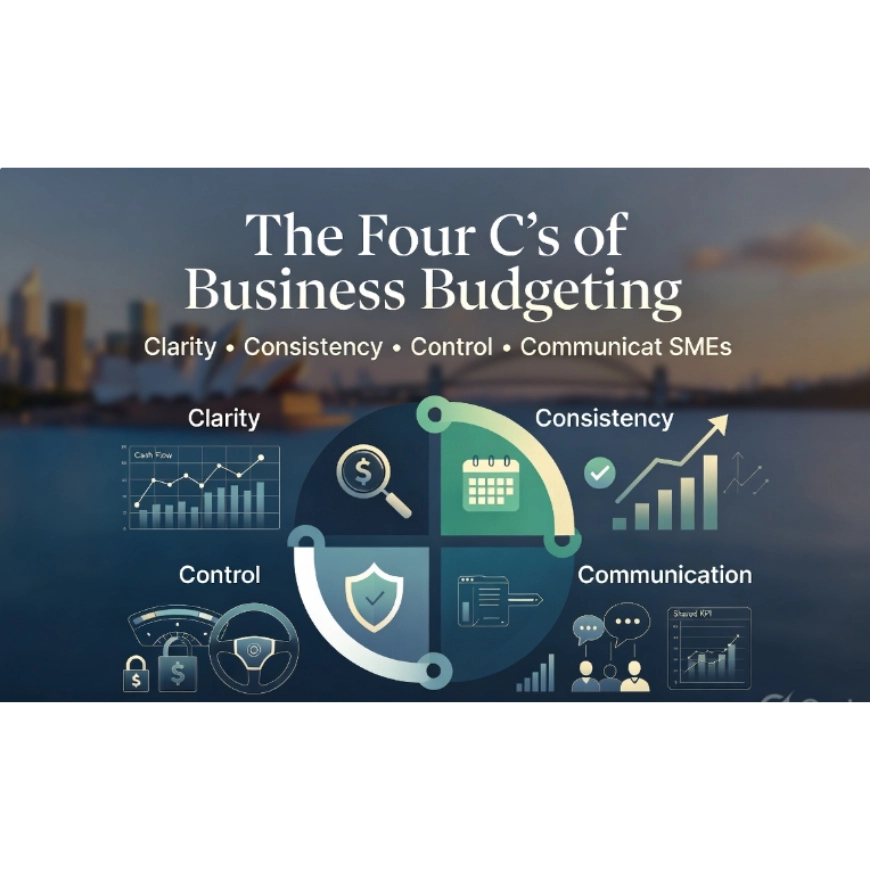


The Four C’s of Business Budgeting: A Sydney Accounting Firm’s 2026 Guide for SME Owners
Have you ever celebrated a record sales month, then checked your business bank account a week later and wondered where the cash went? In many Sydney SMEs, strong revenue is quickly absorbed by payroll, suppliers, GST, PAYG withholding, superannuation, and timing gaps in accounts receivable.
You are not alone. As a Sydney accounting firm supporting SMEs across professional services, construction, eCommerce, hospitality, and trades, we see the same pattern repeatedly: revenue does not equal profit, and profit does not equal cash flow.
The solution is not a more complex spreadsheet. It is a simple, repeatable framework: the Four C’s of Business Budgeting — Clarity, Consistency, Control and Communication.
This 2026 guide explains how each “C” applies to Australian small businesses, with Sydney-specific examples, practical steps, and a four-week implementation plan you can roll out immediately.
Key takeaways (for time-poor business owners)
- A business budget should separate operating cash from ATO liabilities (GST, PAYG, superannuation).
- Weekly routines prevent cash surprises and reduce reliance on overdrafts.
- The strongest budgets include controls for debtor days, subscriptions, and irregular annual expenses.
- A budget only works if your team and advisors can operate it consistently.
Why the Four C’s Matter for Sydney SMEs in 2026
Sydney’s operating environment can be unforgiving: high commercial rents, rising wages and superannuation costs, supply chain volatility, and strict ATO compliance obligations (GST, PAYG withholding, PAYG instalments).
A proper business budget is not about restriction. It is about controlling working capital so you can:
- Meet payroll, superannuation and tax obligations on time
- Build cash reserves to withstand volatility
- Make confident decisions about hiring, equipment and growth
- Extract consistent owner profit (instead of “whatever is left”)
1) Clarity — Know Where Your Capital Is Deployed
Clarity means moving beyond “bank-balance accounting” to understanding what cash is truly available for operations, versus what is already committed.
Sydney example (professional services):
A marketing agency believed it was achieving ~20% net profit. A clarity review identified unbilled scope creep, poor job costing, and redundant software subscriptions eroding margins. After cleaning up job tracking and pricing, cash flow stabilised within a quarter.
How to achieve Clarity (practical steps)
- Separate revenue from obligations immediately:
Identify GST collected, PAYG withholding, superannuation and upcoming ATO payments as not operating cash. - Categorise expenses correctly:
Split costs into COGS (direct delivery costs) versus OPEX (rent, insurance, admin, software, marketing). - Calculate true gross margin and net margin by revenue stream:
Which service line, product category, or job type is actually profitable? - Adopt zero-based budgeting for the business:
Every dollar of projected revenue gets a job: wages, rent, ATO provisioning, debt reduction, buffer, reinvestment, owner drawings.
Accountant tip: Use Xero or MYOB with a customised chart of accounts so your reporting mirrors the way you manage the business (by department, location, product line, or job type).
2) Consistency — Make Budgeting an Operational Routine
A budget is a living system. If you only review the Profit & Loss at tax time, you are making decisions too late.
Sydney example (construction/trades):
A Western Sydney construction firm experienced repeated cash bottlenecks due to sporadic project expense tracking. Weekly reconciliations and consistent job-cost reviews improved visibility and reduced the need for short-term finance.
How to build Consistency
- Schedule a weekly 30-minute cash flow review (same time each week)
Review: bank balance, invoices issued, receipts due, supplier bills, wages, and upcoming ATO obligations. - Reconcile weekly (not monthly):
Clean data is what makes your budget useful. - Run monthly Budget vs Actual reporting:
Track variances and decide what changes: pricing, rostering, purchasing, marketing spend, or debtor follow-up. - Use rolling forecasts:
A 13-week cash flow forecast is often more useful than a static annual budget for SMEs.
3) Control — Protect Profit and Working Capital
Control is the ability to direct business cash flow proactively, rather than reacting to surprises.
Sydney example (eCommerce):
An Alexandria retailer grew revenue quickly, but margin did not improve due to escalating logistics costs. Departmental budgets and supplier renegotiations restored gross margin within two quarters.
Control tactics that work for Sydney SMEs
- Set spending limits by department/category:
Marketing, software, subcontractors, consumables—assign budgets and track them. - Create sinking funds for irregular but predictable costs:
Annual insurance, equipment servicing, certification renewals, licences, franchise fees. - Tighten debtor management (cash conversion cycle):
Clear terms, automated reminders, deposits for large jobs, and active follow-up reduce “profit on paper” problems. - Quarterly subscription audits:
SaaS creep is a silent margin killer—cancel or consolidate tools. - Build a working capital buffer:
Many SMEs target 3–6 months of core overheads, depending on volatility and seasonality.
Control your ATO provisioning (common SME pain point)
If you collect GST and withhold PAYG, consider using separate accounts (or automated transfers) so funds are available when BAS and IAS liabilities fall due. This one change alone can remove a major source of cash flow stress.
4) Communication — Align Owners, Managers and Advisors
Budgets fail when they live only in the owner’s head. Communication ensures the business can execute the plan.
Sydney example (startup):
Two co-founders disagreed on spending priorities (growth vs runway). A structured budget, shared KPIs, and monthly reporting cadence aligned decision-making and reduced conflict.
Communication strategies that work
- Monthly management meeting: review cash flow, Budget vs Actual, and forecast risks.
- Clear expense policies: approvals, limits, and what is claimable.
- Share relevant KPIs with key staff: labour %, gross margin, stock turns, debtor days.
- Talk to your accountant before major commitments: leases, new hires, equipment finance, or dividends/drawings.
4-Week implementation plan (Sydney SME-ready)
| Week | Focus | Actions |
|---|---|---|
| Week 1 | Clarity | Export the last 90 days of transactions. Clean categories. Confirm COGS vs OPEX. Calculate margins by revenue stream. |
| Week 2 | Consistency | Set weekly reconciliation cadence. Schedule weekly cash flow review. Start a rolling 13-week forecast. |
| Week 3 | Control | Implement departmental limits, debtor process, subscription audit, and sinking funds. Establish ATO provisioning process. |
| Week 4 | Communication | Present the budget to managers. Document policies. Book quarterly review with your accountant. |
Tools we recommend for Sydney SMEs in 2026 (by function)
- Xero: cloud accounting with bank feeds and reporting
- Hubdoc: receipt capture and supplier invoice processing
- Fathom / Spotlight Reporting: KPI dashboards and forecasting
- Employment Hero: payroll, rostering and workforce costs
If you tell us your industry, headcount, and turnover, we can recommend an efficient stack without over-engineering.
FAQs (SME budgeting)
Q: Can my bookkeeper handle budgeting?
A: Bookkeepers are essential for reconciliations and day-to-day accuracy. However, budget strategy (pricing, resourcing, margins, buffers, owner drawings) requires owner and advisor involvement.
Q: Are the Four C’s an official Australian accounting standard?
A: No. They are a practical management framework aligned with best-practice management accounting and designed to support strong ATO compliance.
Q: How do we budget with seasonal revenue?
A: Use rolling forecasts and build larger buffers during peak months. We typically recommend a 13-week cash flow forecast plus a 12-month view for seasonal businesses.
Q: How quickly will we see results?
A: Many SMEs gain better cash visibility within the first month. Margin and buffer improvements typically compound over 2–6 months, depending on debtor cycles and cost structure.
Ready to build predictable cash flow in your Sydney business?
If you want help implementing the Four C’s with proper reporting, ATO provisioning, and cash flow forecasting, our Sydney accounting team can assist with:
- Business budgeting and rolling forecasts
- BAS/IAS planning and ATO compliance support
- Tax planning and structuring
-
 CEO & Founder

Share this article:


About Abundance Empowered Financial Solutions
Yvette Lo founded Abundance Empowered to bring enterprise-level financial strategy to Australian small businesses. With over a decade of commercial accounting experience managing billion-dollar company finances, Yvette specialises in transforming bookkeeping from compliance task into strategic advantage. Based in North Shore Sydney, Abundance Empowered serves small businesses throughout Australia through cloud-based platforms, offering bookkeeping, BAS services, strategic advisory, tax planning, and complete financial partnership.
Ready to Take Control of Your Finances?
Stop the financial leaks and build strength ahead of 2026 changes. Contact us today for a free, no-obligation consultation.

